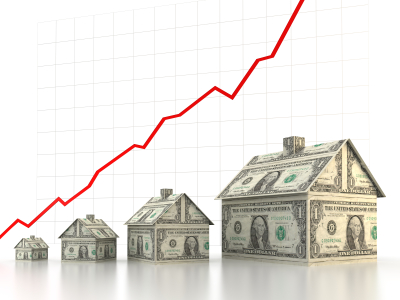
The housing recovery is looking more like another housing boom, with prices rising at a record pace.
The median home price in Southern California surged a stunning 28% in June compared with a year earlier — outpacing any month during last decade's housing bubble. The gain puts the median at $385,000, up from $300,000 last June.
Some experts warn that prices, driven by short supply, should cool off soon. Investors who have flooded the region with cash purchases will probably retreat, they say, as a fresh supply of sellers and builders moves in. But others see nothing but higher prices ahead, with supply staying tight and buyers scrambling to close deals before the window of affordability slams shut.
Syd Leibovitch, founder and president of Rodeo Realty in Beverly Hills, said he expects prices to double from their bottom last year.
"You have a lot of room to run," Leibovitch said. "Because historically, they always double in these cycles, and then they drop back a bit."
For now, many home shoppers are tendering ever-higher offers in cutthroat bidding wars.
"They are following the fiddler," said real estate agent Amber Dolle. "They are hearing that there is this huge panic to get into a home."
The Southland's recovery began last April, when the median home price rose 3.6% year-over-year, to hit $290,000. The recent increases now represent gains on top of last year's increases, rather than rebounds from historic lows. And yet the percentages have continued to grow since crossing the 20% threshold in January of this year.
June's increase is the highest percentage gain recorded by DataQuick since the firm started measuring year-over-year price changes in 1989. The current median is, however, still well below the peak of $505,000 reached in 2007, just before the crash.
The reality for buyers is financially and emotionally draining. Jessica Wilde and her husband Guy wrote a heartfelt letter to the seller of a Covina house, pleading the owner to choose them over an investor. They ultimately won the bidding war — if you define winning as paying $411,000 for a home listed at $360,000.
"I saw it one time for 30 minutes," Wilde said. "When would you ever buy something that expensive, and see it for 30 minutes?"
Such scenarios are giving rise to increasingly optimistic predictions of future home price gains. Hedge fund titan
John Paulson — who made a fortune betting against the housing market before the crash — now says he's bullish on housing.
"It's more or less seven years — seven years up, seven years down — very similar to the Bible," Paulson said
Wednesday during a conference presented by
CNBC and Institutional Investor. "I think we are just at the beginning of the recovery. I would expect this recovery to continue for at least the next four, possibly seven, years."
Southland buyers purchased 21,608 new and resale houses and condos last month, a 2.1% drop from June of last year, and a 6.2% decline from May, an indicator of tight supply. That's the first time sales have declined over the year since September.
Absentee buyers — usually investors — continue to see bargains even with the rapid rise in prices. Their purchases accounted for 28.7% of homes sold, DataQuick reported. Cash buyers made up 30.2%. Both those percentages were declines from May, but still far above historical averages.
Glenn Kelman, chief executive of online brokerage Redfin.com, is in the camp of those who predict the market will chill during the second half of the year.
"The smart money has left the building," he said. "There is not as much investor activity, as the investors have really tired of competing with regular home buyers. And what we have seen in the last few weeks has been a significant slowdown in demand."
Richard Green,
director of USC's Lusk Center for Real Estate, said buying a home is no longer a "slam dunk," given the rise in prices and interest rates, which have jumped a full percentage point since May to about 4.5%. Potential home buyers aren't seeing their personal incomes grow enough to support such eye-popping home price gains, Green said.
"This has just got to stop pretty soon, and I think fall is probably when it will happen," Green said. "People shouldn't expect this to continue for very long. If that is the basis they are buying something — they shouldn't."
Stuart Gabriel, director of UCLA's Ziman Center for Real Estate, dismissed any notion that the market is headed for another bubble.
"It's a striking number, there is no question about it," Gabriel said. But "I don't believe our situation is in any shape or form similar to the situation we faced in the mid-2000s."
A mismatch of supply and demand underlies the recent spectacular home price gains, he said. During the recent slowdown, builders brought new construction to its lowest level since the Great Depression. Then the rapid turnaround caught builders off-guard — and they haven't cranked up production to anywhere near normal levels.
"Builders are still not putting up enough homes," IHS Global Insight economist Patrick Newport wrote
Wednesday morning following news that new home starts declined 10% in June. "Far from it."
Supply remains constrained because many people who own their own homes still owe more on their homes than they're worth. Moreover, sales of foreclosed homes have plummeted to just 9% of the market — down from nearly half of sales in February 2009 — eradicating a source of homes that many experts wrongly predicted would glut the market for years.
Demand for homes remains robust. The recent uptick in interest rates has probably spurred more buyers to close deals, fearing rates will rise more.
Investor demand has waned slightly, but still remains strong, particularly among smaller players dealing in a handful of homes. Further driving demand: A pipeline of people who lost their homes three years ago are reentering the market because they can again qualify for mortgages.
Dolle, the agent specializing in the San Fernando Valley, said she has seen the frenzy ease a bit recently. But multiple offers are still common.
"Everyone is going through this," she said. "Every single buyer I have worked with since probably December has had to pay at asking or above asking."










.png)