Monday, December 12, 2016

The Art and Science of 'Right-Pricing' a Home

Of course, every home for sale comes with an asking price.
Where that price came from, how close it is to today’s actual value, and how likely it is a qualified buyer will pay anything close to that is another matter altogether.
Add to that whether the house has had recent, tasteful upgrades, has been staged like a model home, is in a prime location, has a swimming pool or a killer view and you’re into the difficult science of right pricing a home.
Add further into the equation factors some sellers pack into their desired sales price, and the difficult job of right pricing becomes an art more than a science.
Here are a few examples of right pricing challenges.
• Upgraded to sell: So you have a condo in a great location with an attached garage and you’ve kept it in exactly the same condition as you bought it. Now it’s time to move on and get it sold.
Bring in a designer and a good, reasonably priced contactor, and now you’re the bomb. Quartz. Stainless steel. White. Brushed nickel. Add $20,000 to the recent comps and subtract two months from the time to get it sold.
• Lipstick on the pig: When you have a desirable floor plan in a great location, but don’t have recent, fashionable upgrades, you might just want to replace your light fixtures with something more up to date, change out the cabinet pulls to match the fixtures, give it a new coat of neutral paint and you’ve got a fighting chance of getting a great offer.
As long as you price it closer to the recent sales in more original condition and avoid the lure to ask what the fully remodeled flip just sold for, which is the highest price in the history of the neighborhood.
• Flipping for the big bucks: When you pick up an older house with the most amazing lot in the entire neighborhood (end of the cul de sac, at the top of the hill, with a 180-degree view), you have a unique opportunity to push your asking price even higher.
Say it’s a 1972 home in original condition. Rather than go to market for slightly less than similar recent sales, use your previous flipping expertise. That means flawless design touches, adding a few windows, removing a few walls and hiring a staging company with the best sense of style and emotional appeal.
Do that, and you might get multiple offers and end up selling it for the highest price in the history of the neighborhood.

Read more...

Sunday, November 20, 2016

Post-Election Rate Spike Will Reverse Course

Rest easy. No need to awfulize. Enjoy your Sunday morning hot cup of joe. The Trump win caught markets off-guard. This created a post-election spike in mortgage rates which are going to simmer right back down in the near term.
At press time Wednesday evening, compared to November 8th, lenders raised their conforming 30-year fixed rates between 0.375 percent and 0.5 percent.
What gives?
“Uncertainty is a piece of it,” said Lynn Fisher, vice president of research and economics at the Mortgage Bankers Association “Tax reform or investment in infrastructure stimulates the economy and helps push up prices, (causing) inflation to pick-up.”
Consumer mortgage rates and fees are derived from mortgage backed securities, which in hand closely mimic the 10-year Treasury rate. For the sake of perspective, the 10-year Treasury topped out on Nov. 15 at 2.23 percent, almost exactly where the 10-year was Nov. 18, 2015, when the rate was 2.27 percent.
The low point on the 10-year in 2016 was July 6 at 1.38 percent. That was less than two weeks after the United Kingdom unexpectedly voted to leave the European Union. When conventional expectations don’t come to pass, mortgage markets have spasms one way or the other and then tend to settle back to where they were.
Fisher said that total residential mortgage funding volume in 2015 was about $1.7 trillion. The MBA projects that 2016 will land at $1.9 trillion. It expects $1.6 trillion in 2017, with purchases climbing 11 percent and refinances falling off.
There is “nothing obvious to keep rates rapidly increasing,” she added.
The silver lining for home sellers is that interest rate events tend to get procrastinating buyers off the fence.
“There is a concentration of buyers that are ready to look because all of the talk that rates are going to go up,” said Candice Blair, broker of Niguel Point Properties.
Comparing a loan amount of $417,000 on a 30-year fixed rate at 3.25 percent of a few weeks ago to today’s rate of 3.75 percent, the mortgage payment increase is $116, or a principal and interest payment of $1,931. Yes, a big jump indeed.
If the Federal Reserve raises rates in December, adjustable rate mortgages will go up a tad.
I’m doubling down. My tea leaves and my crystal ball both show mortgage rates settling back down, at least between now and right after President-elect Trump’s Jan. 20 inauguration. If it were me, I’d float the rate and not lock in until you are cleared to close.

Read more...

Wednesday, November 16, 2016

Californians Fleeing State's High Cost of Housing

California’s warm weather, sunny beaches and world-class schools have lured people to the Golden State for decades, but rising home prices are turning that equation around.
Data analysis firm CoreLogic says that for every two homebuyers who moved to California from 2000 through 2015, five others sold their homes, packed up and moved out.
Arizona and Texas were the top destinations for people moving out of California, CoreLogic reported. Only New Jersey had a higher ratio of fleeing homeowners during that period.
“California had the largest number of out-migrants in 2015,” CoreLogic Senior Economist Kristine Yao said in a blog post published Thursday.
The trend of out-migration was also noted in a separate trio of reports released earlier this year by Beacon Economics. Beacon noted that 625,000 more U.S. residents left California between 2007 and 2014 than moved into the state. The vast majority ended up in Texas, Oregon, Nevada, Arizona and Washington.
The search for more affordable housing is sending low- and middle-income workers out of the state, while higher-wage workers continue to move in, which argues against the theory that high taxes are driving people away.
“California has an employment boom with a housing problem,” said Beacon founding partner Christopher Thornberg. “The state continues to offer great employment opportunities for all kinds of workers, but housing affordability and supply represent a significant problem.”
Home prices and rents have been rising steadily for more than four years.
CoreLogic figures show Orange County’s median home price was up 42 percent in the four years ending in September. Prices were up 55 percent in Los Angeles County, 57 percent in Riverside County and 75 percent in San Bernardino County.
Although home sellers leaving California last year paid, on average, 36 percent less for their new homes out of state, they tended to end up in better neighborhoods, CoreLogic reported. Their purchase prices ranked in the 77th percentile for their new metro areas, while their sale prices ranked in the 62 percentile back home.
“Of the homeowners moving out of state, more of them sold in high appreciation, high cost areas and bought in lower appreciation, more affordable areas,” Yao wrote.
California home prices have risen in part because of a lack of inventory.
From 2005 to 2015, permits were filed for only 21.5 housing units per every 100 new residents in the state. That put the Golden State second to last behind Alaska, where only 16.2 housing permits were filed for every 100 new residents.
On the flip side, Michigan saw 166 permits filed for every 100 new residents.

Read more...

Thursday, October 13, 2016

The Past, Present & Future of Home Prices

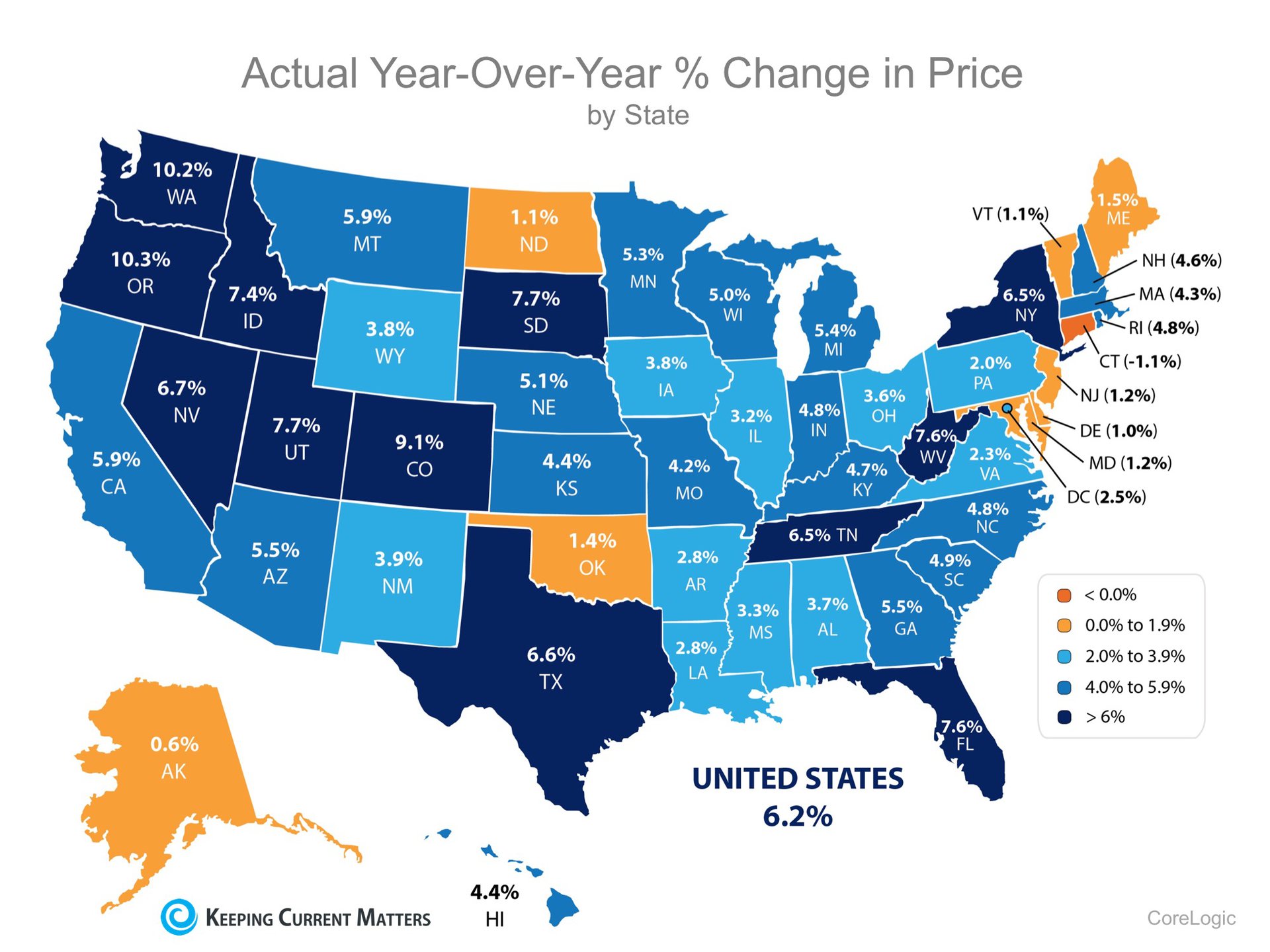
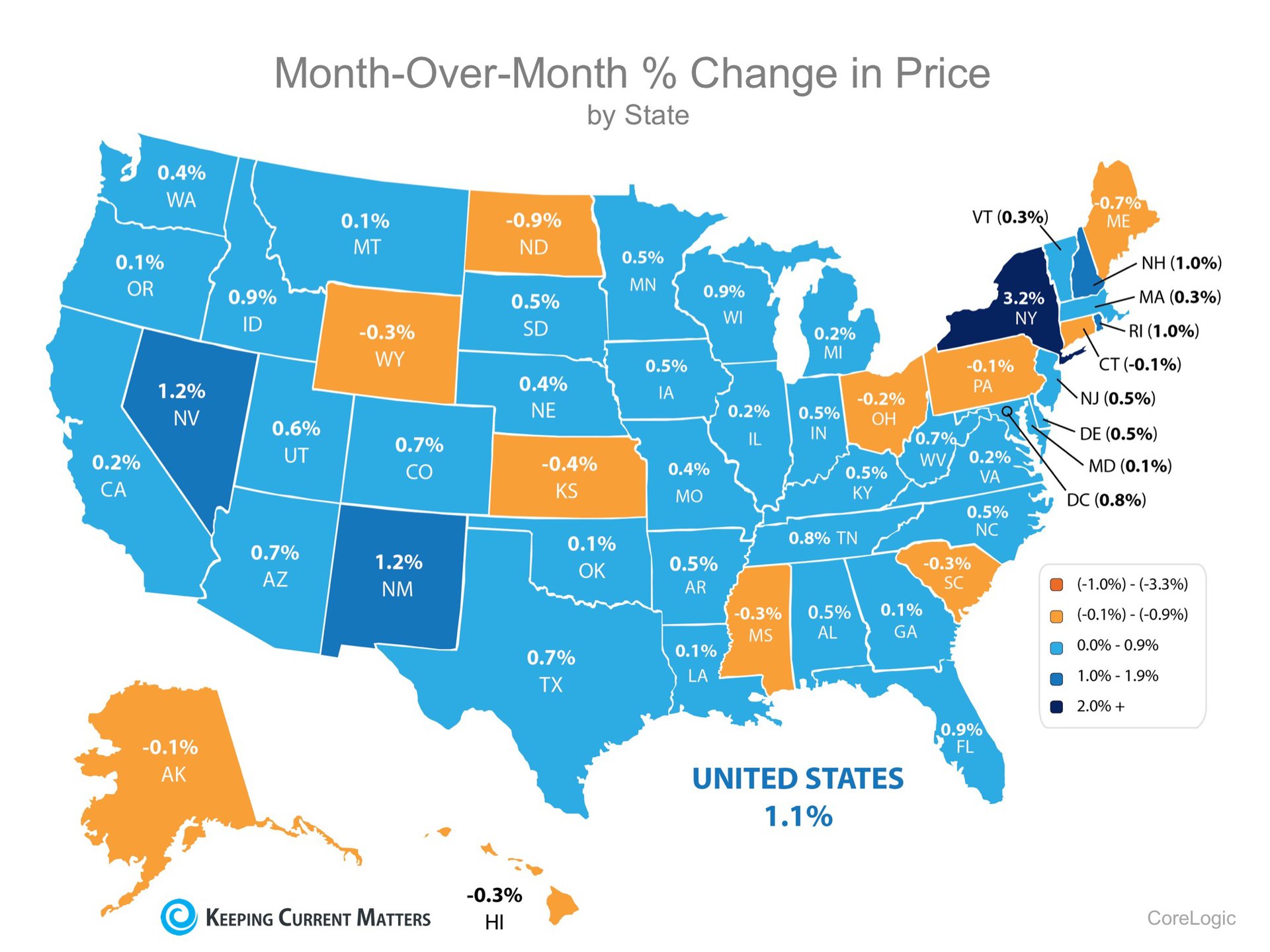
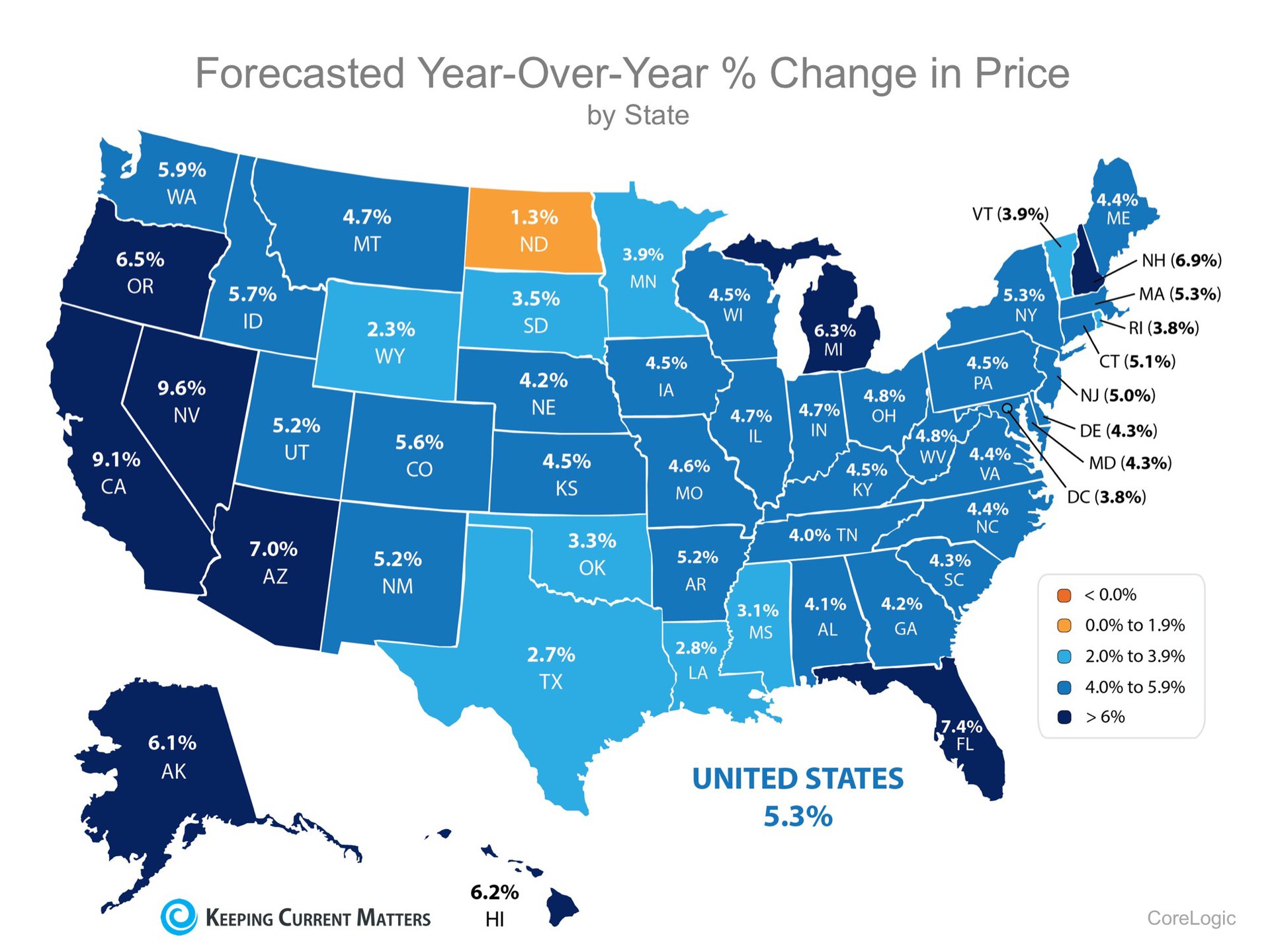
CoreLogic released their most current Home Price Index last week. In the report, they revealed home appreciation in three categories: percentage appreciation over the last year, over the last month and projected over the next twelve months.
Here are state maps for each category: 

The Past – home appreciation over the last 12 months

The Past, Present & Future of Home Prices | Keeping Current Matters

The Present – home appreciation over the last month

The Past, Present & Future of Home Prices | Keeping Current Matters

The Future – home appreciation projected over the next 12 months

The Past, Present & Future of Home Prices | Keeping Current Matters

Bottom Line

Homes across the country are appreciating at different rates. If you plan on relocating to another state and are waiting for your home to appreciate more, you need to know that the home you will buy in another state may be appreciating even faster.
Meet with a local real estate professional who can help you determine your next steps.

Read more...

Monday, August 29, 2016

Are Open Houses Worth It?

Between cleaning, getting the sellers out of the house, breaking out the cheese and crackers and uncorking a bottle of wine, open houses are a burden for you and your sellers. But what if you were to find out it’s not always worth the time, talent and effort?
For most of California, it is. But the truth is, having an open house doesn’t always help you to sell a home more quickly — or for a higher price.
Homes with open houses tend to sell for above the asking price and more quickly in California, according to a report by Redfin, a national real estate brokerage. The report analyzed sales data of homes in markets where Redfin is active going back to 2010.
However, the signals are decidedly mixed. Across California, the difference varies by region. In:
  • San Francisco, 74% of homes with open houses sold above asking compared to 47% of those without an open house;
  • San Jose, 65% of homes with open houses sold above asking compared to 47% of those without an open house;
  • Los Angeles, 36% of homes with open houses sold for above asking compared to 29% of those without an open house;
  • Oakland, 65% of homes with open houses sold above asking compared to 49% of those without an open house;
  • Sacramento, 13% of homes with open houses sold above asking compared to 12% of homes without an open house; and
  • Orange County, 18% of homes sold above asking, the same as without an open house.
On the other hand, homes in Ventura, Riverside and San Diego tend to sell for less when the agent holds an open house.
What accounts for the difference? Some homes simply present better than others in person, or are located in desirable areas with significant foot traffic. Further, take the above Redfin study with a big grain of salt: their data may be skewed by the fact that agents tend to hold open houses only for those homes that are in coveted locations and in prime condition, and therefore already more likely to sell for more and to sell quickly.
In other words, agents are more motivated to host open houses when they have an attractive listing they want to show off. And why not? Open houses are just as much about the agent getting to know the nosy neighbors who stop by as they are about trying to solicit interested homebuyers.

Read more...